“The Torah has seventy faces; each one reflects a spark of the divine light”
— Zóhar I, 47a
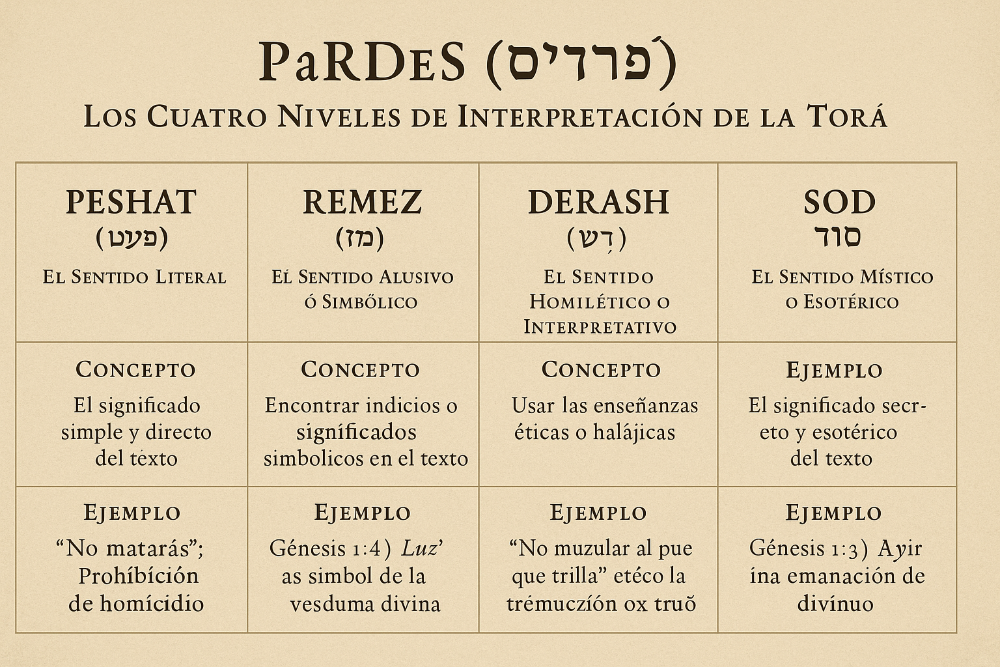
The term PaRDeS (פרד״ס) comes from the initial Hebrew of Peshat, Remez, Derash, and Sodthe four levels of classic interpretation of the Torah. The word itself, pardés, literally means “garden” or “garden”, and is the root of the word “paradise”. The metaphor refers to the gradual garden spiritual where each level of understanding reveals a greater depth of the sacred text.
The PaRDeS is not only a method of exegesis; it represents a model ascension intellectual and spiritual. Each level does not invalidate the previous one, but contains and transcends, forming a hierarchical structure where the literal sense is the basis, and the mystic is the cusp.
VIDEO IN SPANISH
1. PESHAT (פְּשָׁט) — The Literal Sense
Concept
Peshat it means “simple” or “plain”. It is the interpretation the literal and contextual of the biblical text, looking for his meaning and grammarwithout the addition of allegory or symbolism. This level is based on the language, the syntax, the history and the logic of the passage.
Foundation
The Peshat is the foundation of all biblical understanding. According to the sages, “Ein mikrá yotzé midei peshutó” —“no verse can be released from its literal meaning” (Talmud, Shabbat 63a).
Example
When the Torah says in Exodus 20:13 “thou shalt Not kill”, the Peshat teaches exactly that: a prohibition to commit murder. Does not imply, in this level, allusions, metaphorical or interpretations moral hidden.
Application
This level is essential for the study halachic (legal) and educational. Philologists such as Rashi, Ibn Ezra and Rashbam worked extensively within the framework of the Peshat, looking for the sense is more faithful to the text.
2. REMEZ (רֶמֶז) — The Sense Allusive or Symbolic
Concept
Remez means “sign” or “allusion”. This level explores the hidden meanings or symbolic the text, discovering what is hinted at beyond the literal. Relates to the idea that the Torah contains multiple levels of wisdom, encoded in words, numbers, or structures.
Foundation
The Remez is linked with the method of guematría, acrostics, symbolism numeric and analogies philosophical or moral. It is common in the writings of the Midrash and the comments of the kabbalists.
Example
In the verse, “And God saw that the light was good” (Genesis 1:4), the Remez can interpret “light” as divine wisdom or the Torah itself, implying that the “good light” is the spiritual wisdom that enlightens the world.
Application
The Remez allows you to view connections between verses and concepts dispersed, revealing hidden patterns that point to a cosmic order or ethical. It is used by commentators such as Nachmanides (Ramban), who saw in every word an echo of the divine-secrets.
VIDEO IN ENGLISH
3. DERASH (דְּרַשׁ) — The Sense Homiletical or Interpretive
Concept
Derash (from the root “darash”, “search” or “ask”) refers to the interpretation exegetical and homiletic it draws lessons ethical, legal, or spiritual text. This level seeks to apply the Torah to the practical life and moral of the jewish people.
Foundation
The Derash is manifested in the Midrash and in the Halachah (jewish law). It is the level where the rabbis used the rules of hermeneutics of Hillel, Ishmael and Eliezer to derive laws and moral principles.
In this sense, the text becomes a living source of wisdom that guide human behavior.
Example
The verse “thou shalt Not muzzle the ox that trilla” (Deuteronomy 25:4), in the Derash, is interpreted as an ethical teaching: as well as the animal should enjoy the fruit of their work, also the worker deserves his reward (see 1 Corinthians 9:9 as parallelism in the pauline tradition).
Application
The Derash integrates context, moral theology. The sermons rabbinical and the parables midráshicas derived from this level, making it the Torah dialogue with the day to day life.
4. SOD (סוֹד) — Meaning Mystical or Esoteric
Concept
Sod means “secret” or “mystery”. Is the level esoteric, kabbalistic and metaphysical of the Torah, reserved for those who reach spiritual maturity and moral purity. In this plane, the text reveals the realities hidden in the universe, and the emanations of divine (Sephiroth) and the processes of Creation.
Foundation
The Sod is based on the texts of the Zóhar and in the mystical tradition of judaism, which sees the Torah as a code divine spiritual energy. Every letter, every word and every combination number has a creative power and a metaphysical meaning.
Example
In the verse “let There be light” (Yehi or), the Sod teaches that the “light” is not the physical light, but a emanation of the primordial light (Or Ein Sof), a manifestation of the Deity before the creation of the sun or the stars.
Application
The Sod is the level of the Kabbalah. His study seeks union with the divine (devekut), and the understanding of the ultimate purpose of the cosmos.
The kabbalists, as the Ari HaKadosh (Isaac Luria), and the Zóharto interpret the other three levels are only veils that protect the light of the Sod.
Relationship between the Four Levels
| Level | Type of Interpretation | Objective | Method | Brief Example |
|---|---|---|---|---|
| Peshat | Literal | To understand the text according to its basic sense | Language, context, grammar | “Thou shalt not kill” = ban literal |
| Remez | Symbolic | Discover hidden meanings | Guematría, allegory | “Light” = divine wisdom |
| Derash | Homiletical | Learn a moral or legal | Midrash, rules rabbinical | “No muzzle” = worker justice |
| Sod | Mystical | Reveal the secrets of the divinity | Kabbalah, meditation | “Light” = divine emanation |
Conclusion
The system PaRDeS is a scale of spiritual ascension and cognitive within judaism.
The student who enters these levels are not only interprets a text, but explore the planes of Being and of the Divinity.
- The Peshat teaches the discipline of the intellect.
- The Remez awakening intuition.
- The Derash shape the ethical consciousness.
- The Sod reveals the mystery of existence.
Each one is a gate from the same garden. Only those who integrates all reached the true pardés: the paradise of the total comprehension of the Torah.