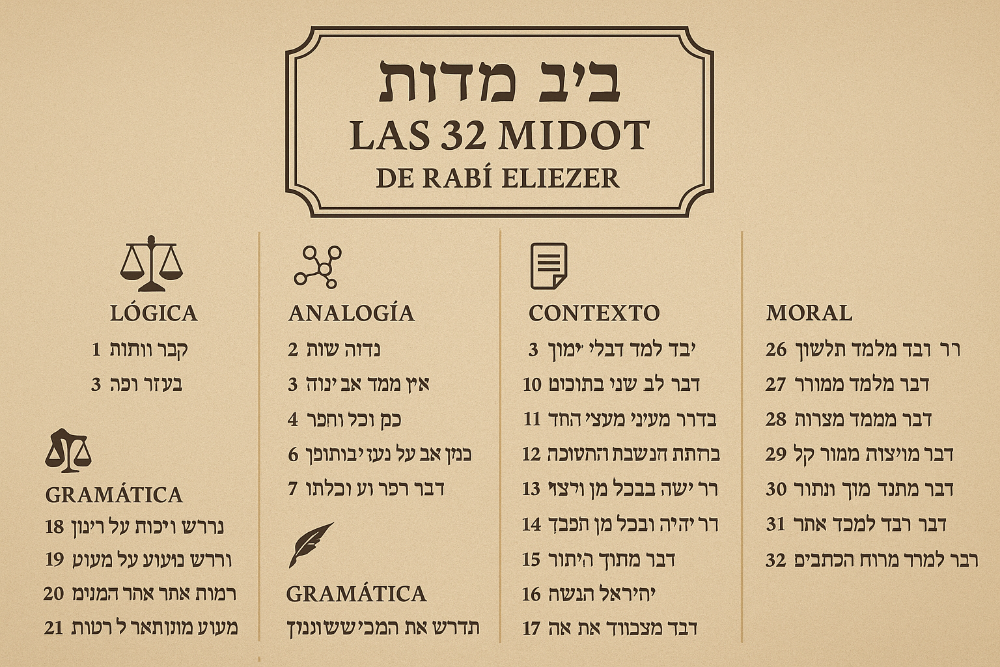
“The Torah has seventy faces; one who learns to look at one, has not been understood yet,” — Rabbi Eliezer ben Yose HaGelili
The 32 Middot Rabbi Eliezer differ from the 7 rules of Hillel and the 13 rules of Rabbi Ishmael in that there's not much focus on the halachah (law practice) but in the interpretation homiletic, ethical, and narrative of the biblical text.
These rules were preserved, mainly in the Baraita of 32 Middot, a tradition quoted by the sages of the Talmud, and referred to by Rabbi Eliyahu of Vilna (the Vilna Gaon) and other commentators of the middle ages.
The 32 Middot of Rabbi Eliezer ben Yose HaGelili
Are set out below the 32 ruleswith its Hebrew name, definition, explanation, and an illustrative example:
VIDEO IN SPANISH
1. קל וחומר (Kal Vachomer) – A fortiori
Definition: Reasoning from lesser to greater or vice versa.
Explanation: If something applies in a mild case, with greater reason applies in a more serious one.
Example: If the israelites were to obey Moses, who was a man, how much more must obey God himself!
2. גזרה שוה (Gezerah Shavah) – Analogy-verbal
Definition: Compare two passages with a word or expression.
Example: The word “Shabbat” it appears both on the seventh day of the creation and in the giving of the Torah; it is inferred a connection between the two.
3. בנין אב מכתוב אחד (Binyan Av MiKatuv Echad) – Principle derived from a single text
Definition: Remove a rule from a single verse.
Example: Of the prohibition of work on Shabbat, it generalizes to other holy days.
4. בנין אב משני כתובים (Binyan Av Mishnei Ketuvim) – Principle derived from two texts
Definition: A general education is inferred from the coincidence of two different texts.
Example: The obligation of rest both on Yom Kippur, as on Shabbat.
VIDEO IN ENGLISH
5. כלל ופרט (Klal uPrat) – Generalization and specification
Definition: When a text is usually followed by a particular case, the law applies only to the specific case.
Example: “You'll bring your animals: oxen, sheep...” → only those types.
6. פרט וכלל (Prat uKlal) – Specification and generalization
Definition: Otherwise: if the specific text is followed by one general, expands the scope of the law.
Example: “Oxen, sheep, and all you have...” → includes all types of livestock.
7. כלל ופרט וכלל (Klal uPrat uKlal) – General-specific-general
Definition: Is interpreted only that which is similar to the intermediate case.
Example: “Fruit and cereals and all products of the earth” → only refers to agricultural products, edible.
8. דבר הלמד מעניינו (Davar haLamed meInyano) – Interpretation by context
Definition: The meaning of a verse is understood according to its immediate context.
Example: “An eye for an eye” → is interpreted as monetary compensation, according to the legal context.
9. דבר הלמד מסופו (Davar haLamed miSofó) – Interpretation by the end of the text
Definition: The sense of a passage is clarified when considering your conclusion.
Example: In the laws of purity, the end shows that the purpose is moral, not merely physical.
10. שני כתובים המכחישים זה את זה עד שיבוא הכתוב השלישי (Two texts contradictory to that a third-party harmonizes)
Example: A verse says, “God repented” and the other “God does not change;” a third text (“I am the Eternal, I do not change”) makes it clear that repentance is figurative.
11. גזירה שוה לשון יתירה (Analogy-based word redundant)
Explanation: If a word appears in an apparently superfluous, its repetition suggests connection.
Example: “These are the commandments,” in two different locations indicates a common teaching.
12. נדרש תחילת המקרא מסופו וסופו מתחילתו (Interpretation circular)
Definition: Sometimes the start of the verse is explained by the end, and vice versa.
Example: In the Psalms, the first line is clarified by the close of the same verse.
13. כל מקום שנאמר השמר פן ואל אינו אלא לא תעשה (All warning means a ban)
Example: “Beware of forgetting the Lord” → is not a piece of advice, but an effective ban.
14. כלל שנאמר בזה וחזר ונשנה בזה (Rule repeated in different contexts)
Definition: When a law appears twice, once clarifies and expands upon the other.
Example: The prohibition of idolatry in Exodus and Deuteronomy.
15. דבר שהיה בכלל ויצא מן הכלל ללמד (Something included in a rule that is mentioned apart to teach something new)
Example: “Thou shalt not seethe the kid in its mother's milk” → is repeated three times to indicate three different applications (eating, cooking, profit).
16. דבר הלמד בהיקש (Analogy or comparison theme)
Definition: Relationship between two laws contiguous or common theme.
Example: Shabbat and Mishkán are compared: the work of the Mishkán define prohibited on Shabbat.
17. מיעוט וריבוי (Limitation and expansion)
Explanation: Game between restriction and inclusion according to the text.
Example: “All the fruit of the trees” → “all” expands, “the trees” limits.
18. דבר הלמד מן ההקשר הרחב (Learning by the broader context)
Example: To understand a commandment not only by the verse immediately, but throughout the chapter.
19. נדרש ריבוי על ריבוי (Inclusion repeated reinforces the scope)
Example: “All, whole, every one” → emphasizes universality.
20. נדרש מיעוט על מיעוט (Reiteration of limitation excludes more even)
Example: Two exclusions successive involve a restriction total.
21. סדר המקראות (Order of the verses)
Explanation: The order of the text is significant; change can alter the sense.
Example: The sequence of the sacrifices in Leviticus indicates priority.
22. דבר שהיה בכלל ויצא לדון בדבר חדש (Except with teaching independent)
Example: The laws of the nazarite, that while they include sacrifices, they have their own rules.
23. דבר הלמד מסברא (Derived from the logical reason)
Example: If the Torah commanded to love our neighbour, it is understood not to damage it.
24. דבר הלמד ממסורת (Learned by oral tradition)
Example: Details of the tefillin, or of the mezuzah are not written, but are known through tradition.
25. דבר הלמד מן הסיפור (Derived from the biblical account)
Example: The hospitality of Abraham is a model of morality to the jews.
26. דבר הלמד מדקדוק הלשון (Derived from the grammar or syntax)
Example: The use of a verb singular instead of plural, you change the application halachic.
27. דבר הלמד ממילת יתירה (Learning of a word added)
Example: “And God spake Moses” – the inclusion of a name may have a purpose of interpretation.
28. דבר הלמד מחסר ויתר (omissions or additions)
Example: When you lack a word or there is an added, extracts a hidden meaning.
29. דבר הלמד מסמיכות (proximity textual)
Example: If a command is beside another, it is assumed a moral relation, or practice between the two.
30. דבר הלמד ממניין (enumeration or number)
Example: When the Torah lists seven species of the land of Israel, each one has symbolic value.
31. דבר הלמד מהיקש הפוך (Contrast between the two laws)
Example: Compare Shabbat (rest) with Yom Kippur (atonement) reveals essential differences.
32. דבר הלמד מרוח הכתובים (The general spirit of the Scriptures)
Definition: It is interpreted in accordance with the ethical tone and theological global of the Torah.
Example: All interpretation must reflect justice, compassion, and holiness.
Conclusion
The 32 Middot Rabbi Eliezer represent a advanced method of spiritual exegesis, and literary, where the Torah is seen as a text multidimensional. Do not seek only to determine the law, but reveal hidden meanings, ethical, and symbolic.
These rules became the basis of the Midrash Rabbah and the interpretive methods used by the wise and medieval kabbalists.