"As well as the water can never be exhausted, nor the Torah ceases to be renewed in those who study it every day" – Midrash Rabbah (Vayikra Rabbah 9:3)
1. Historical Origin
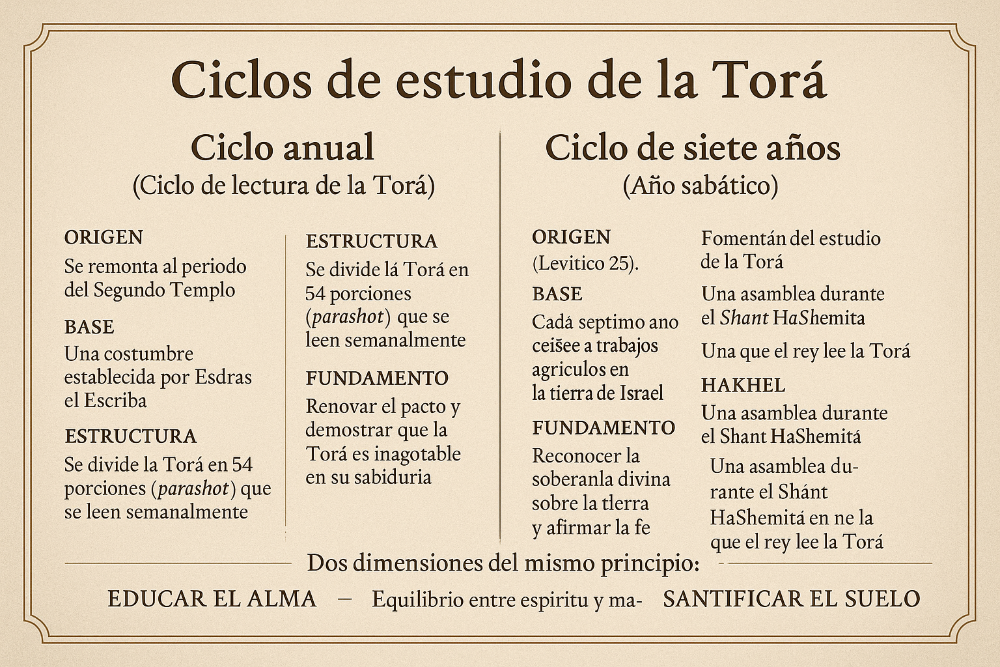
The annual cycle reading of the Torah has its root in the ancient jewish custom of reading publicly the sacred text during the services of Shabbat and the holidays. According to the Talmud (Bavá Kamá 82a)this practice was instituted by Ezra the Scribe (Ezra HaSofer) in the period of the Second Temple (the fifth century.C.)with the aim of keeping alive the connection of the people with the Law after the babylonian exile.
In its origins coexisted two systems:
- The annual cycleadopted by communities of Babylon: complete reading of the entire Torah in one year.
- The three-year cycle, used in the Land of Israel: it is divided into three or three and a half years.
With time, particularly after the destruction of the Second Temple (70 ce.C.), the cycle babylonian annual imposed as standard in the jewish diaspora and continues today.
VIDEO IN SPANISH
2. Structure of the Annual Cycle
The Torah is divided into 54 servings per week (parashot), which are read every Sabbath. In years with fewer weeks, some portions are combined. The cycle begins at Simchat Torah (end of Sukkot) with Bereishit and ends the following year with Vezot Habrajá.
General distribution:
- Genesis (Bereshit) – 12 servings
- Exodus (Shemot) – 11 servings
- Leviticus (Vayikrá) – 10 servings
- Numbers (Bamidbar) – 10 servings
- Deuteronomy (Devarim) – 11 servings
Each week, in addition to the parashahit reads:
- A haftará (passage of the Prophets related thematically).
- Sometimes, it adds special read (maftir) according to the calendar (for example, Shabbat Shekalim, Shabbat Zachor, etc).
3. Basis and the Purpose of Spiritual
The annual cycle symbolizes the constant renewal of the covenant between God and Israel. The Torah is not studying once and for all: is “restarted” every year to show that his wisdom is inexhaustible.
In the words of the Midrash Tanjumá:
“Each day the Torah must be new in your eyes.”
This weekly rhythm creates a structure of community study uniform throughout the world, so that all of the jewish communities they read the same torah portion simultaneouslyby strengthening the spiritual unity of global jewish people.
VIDEO IN ENGLISH
4. Public reading and Private
The public reading is done:
- Monday and Thursday morning, and Shabbat (minimum three aliyot).
- Rosh Jodesh, feasts and fasts (with readings specific).
In addition, the annual cycle is the basis for programs daily study, as:
- Daf Yomi (a page of the Talmud every day).
- Parshat HaShavúa (study of the weekly portion with classical commentaries: Rashi, Ramban, Ibn Ezra, etc).
II. Agricultural cycle of Seven Years (Shnat HaShemitá)
1. Biblical Origins
The cycle of seven years is based in the Torah itself, mainly in:
- Exodus 23:10-11
- Leviticus 25:1-7
- Deuteronomy 15:1-10
Every seventh year, the Land of Israel must rest (shemitá = “release” or “cessation”). Not sown, no harvest for the profit and cancel the debts. This command connects the agriculture, economy and spirituality.
2. Theological and Ethical
The Shemitá teaches three essential principles:
- Property divine of the earth: the man is just a guardian.
- Trust in Providence: let it rest for the land, and trust in God for subsistence.
- Social equality: during the Shemitá, the fruits are of free access; the rich and the poor become equal.
The seventh year also had a dimension spiritual and educational: a time for to devote himself to the study of the Torahsince the work of the field stop.
3. The Hakhel – Assembly of the Seventh Year
During the Shemitá, they performed the ritual of Hakhel (Deut. 31:10-13):
After the festival of Sukkot, the king of Israel read the Torah before all the people gathered in Jerusalem.
This event —a kind of “national renewal of the covenant”— represented the culmination spiritual cycle septennial.
4. Modern Application
Today, the precept agricultural applies in Israel in various forms halájicas (heter mejirá, otzar beit din, etc).
In the scope of the study, the Shemitá has inspired modern programs of “Shemitá spiritual”a year of pause for learning, reflection, and the intensive study of Torah, especially in yeshivot.
III. Comparison between the Two Cycles
| Appearance | Annual Cycle | Cycle of 7 years (Shemitá) |
|---|---|---|
| Duration | 1 year | 7 years |
| Text-based | Institution post-exílica (Ezra) | Biblical mandate (Leviticus 25) |
| Approach | Public reading of the Torah | Rest agricultural and intensive study |
| Rhythm | Weekly (54 servings) | Seven-year (6 years working + 1 standby) |
| Spiritual aim | Renew the covenant and wisdom | Remember god's sovereignty over the land and to encourage the faith |
| Character | Collective (synchronized worldwide) | National (centered in the Land of Israel) |
| Social dimension | Unity spiritual and educational | Economic equality and social justice |
IV. Conceptual Synthesis
Both cycles represent two dimensions of the same principle:
the Torah as the pace of life.
- The annual cycle organizes the time, human and community: each week, a fragment of the divine word.
- The cycle seven-year mandates the time of nature and the earth, remembering that everything belongs to God.
The one educates the soulthe other he sanctifies the ground; together they create a balance between the spirit and matter, the intelligence and action, the day-to-day and the eternal sight.