“Do not seek the Torah to fold your understanding, elevate your understanding to achieve the Torah.” — Attributed to Rabbi Hillel the Elder
Rabbi Hillel lived in the I century a.C. and was a contemporary of Herod. His great legacy was not only his humility and moral wisdom, but also to have laid the foundations of the method of exegesis that would allow the sages of the Sanhedrin to derive laws (halachot) from the texts of the Torah.
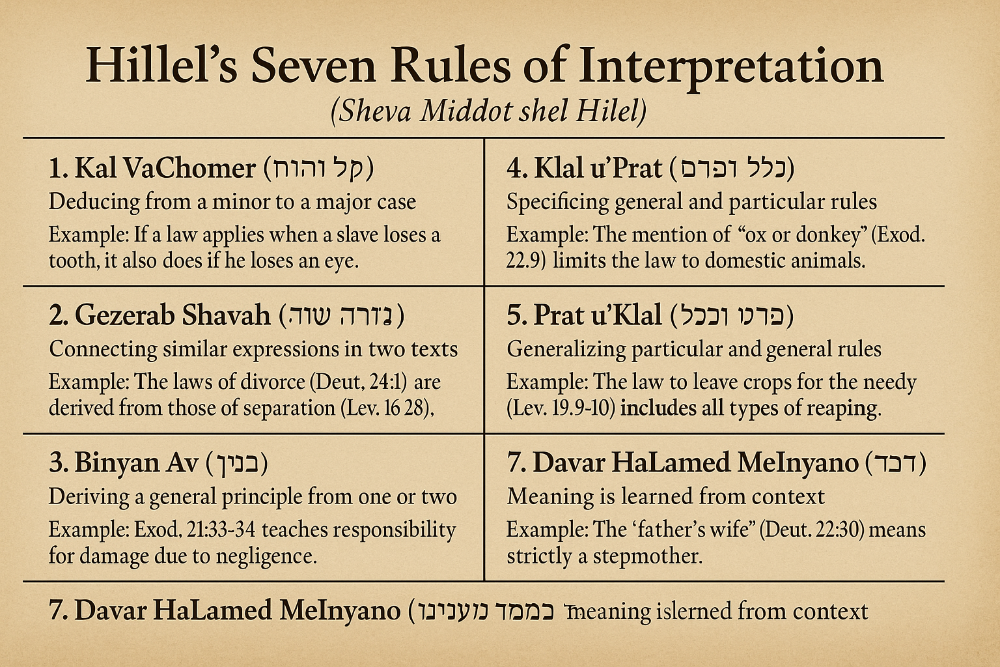
Before Hillel, the interpretation of the Law depended upon oral traditions without a formal methodology. Hillel structured such interpretations in seven logical rulesinspired both in the aristotelian logic, as in the tradition midráshica. These rules are not mere logic games: these are spiritual tools to discover your inner sense (sod) and practical application (halachah) of the Torah.
VIDEO IN SPANISH
1. Kal VaChomer (קל וחומר) — From lesser to greater
Concept
It is an argument a fortiori: if a law applies to a mild case, with greater reason will be applied to a more severe; and vice versa.
Example
In Exodus 21:26-27 states that if a master takes his slave, and you damage an eye or a tooth, you must release it.
Kal VaChomer: If released by losing a single tooth, with greater reason should be released if the master will destroy life or a vital organ!
Application
This principle is widely used in the Halachah, and also appears in the Talmud. For example:
“If the shabbat, which is more severe, it allows to save lives, how much more the common days!”
2. Gezerah Shavah (גזרה שוה) — Analogy for verbal or textual
Concept
When two passages contain a word or expression, it can be inferred that they share the same law or principle.
Example
In Deuteronomy 24:1 is mentioned the term “sefer keritut” (the book of divorce). In Leviticus 16:28 the same word is used “keritut” (separation).
From this coincidence, the sages infer similarities between the procedures of separation ritual and civil divorce.
Application
It is applied with great caution: only the wise who received a oral tradition legitimate can be used Gezerah Shavah, since not all matching text is interpretativamente valid.
VIDEO IN ENGLISH
3. Binyan Av (בנין אב) — Construction of a general principle
Concept
Is to derive a general principle from one or more specific cases.
There are two types:
- Binyan Av mi-Katuv, Cast: based on a single text.
- Binyan Av mi-Shnei Ketuvim: based on two texts concordant.
Example
Exodus 21:33-34 teaches that those who shall open a pit, and causes damage is responsible.
Here we derive a general principle (Binyan Av): the one who causes the damage with its neglect is responsible, although in other circumstances (fire, animals, etc).
Application
It is used to establish legal foundations from concrete examples, creating coherence between the different laws of the Torah.
4. Klal u Prat (כלל ופרט) — General and particular
Concept
If the Torah mentions first one general rule (klal) and then specifies (prat), the law is limited only to what is specified.
Example
Exodus 22:9 says:
“If someone delivers to his neighbor, a pet, or ox, or donkey, or any animal to keep...”
Here are a klal (“animal”) followed by a prat (“ox, donkey”).
Conclusion: the law refers only to the pets and not to the entire class of animals.
Application
Helps to delimit the scope of the laws, avoiding interpretations too broad or out of context.
5. Prat'u Klal (פרט וכלל) — Particular and general
Concept
This is the reverse of the previous rule. If you are first mentioned specific cases (prat), and then a general rule (klal), then the generalization extends the scope to everything that resemble the particular cases.
Example
Leviticus 19:9:
“When you harvest your field, do not reap to the last corner... nor gather the spikes fall.”
Then, in verse 10, it says: “you will Leave for the poor and the stranger”.
Here the klal end extends the standard all forms of harvesting agriculturalnot only ears.
Application
This rule expands the beginning when the text suggests, showing that the Torah may use examples as an illustration, not limitation.
6. Kayotze Bo MiMakom Acher (כיוצא בו ממקום אחר) — Comparison by context parallel
Concept
You interpret a passage in the light of other similar that the subject matter is similar, to clarify meanings, or resolve contradictions.
Example
In Leviticus 1:10 speaks of the sacrifice of sheep and goats; Numbers 28:4 also.
If one is detailed rules that are not in the other, it is assumed that both share the same conditions (kayotze bo).
Application
Allows harmonize texts and complete information when the Torah is similar themes in different sections.
7. Davar HaLamed MeInyano (דבר הלמד מעניינו) — The meaning is learned in the context
Concept
The meaning of a word or phrase should be inferred depending on the context immediate or general where it appears.
Example
In Deuteronomy 22:30 it is prohibited for a man to “take his father's wife”.
The context shows that it refers to a stepmothernot the biological mother.
Application
This rule is essential to avoid literal interpretations out of context and preserve the coherence of the law.
Conclusion
The Seven Rules of Hillel they represent the first attempt encode biblical hermeneutics within the rabbinic judaism. They constitute the point of departure for the 13 rules of Rabbi Ishmael and the 32 of Rabbi Eliezer ben Yose ha-Galili.
More than simple methods of deduction, are principles of reasoning spiritual, where logic and faith are to understand the Divine Will expressed in the Torah.